
Preparing a Bowler to Return to Cricket: Why Running Again Wasn’t Enough
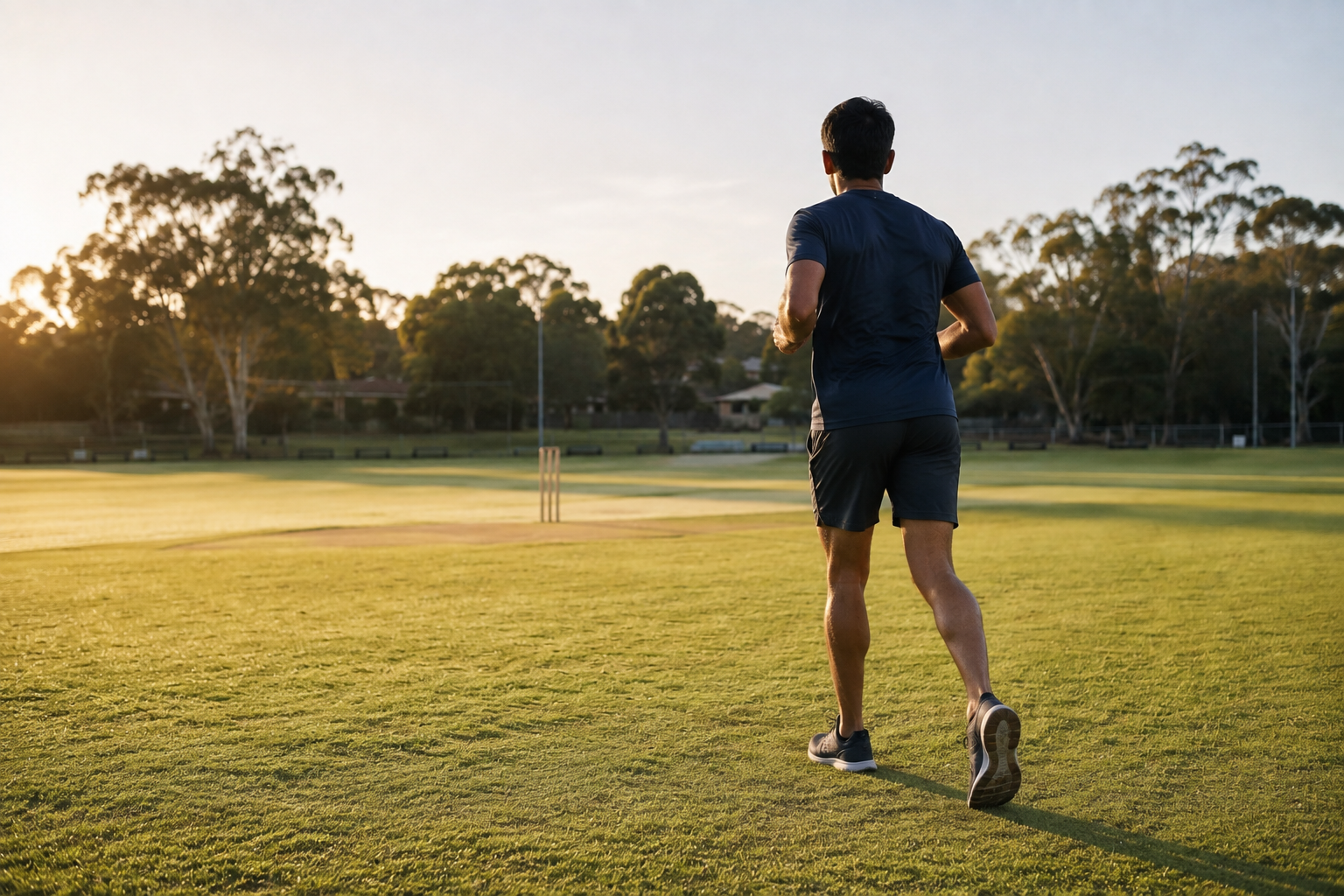
A 37-year-old client came into K-Flow Therapy with pain around both heels, both shins and the back of his knees.
Earlier in his life, he had competed as a semi-professional runner. But work and life had taken over, and he had spent around five or six years away from regular running.
Recently, he decided to start again.
He returned to running and also began playing football. Instead of gradually feeling fitter, pain began building through both heels and shins, with additional discomfort behind the knees.
He had already been assessed at hospital and undergone an MRI, but he was told that no significant problem had been identified.
The symptoms were still very real.
Both heels were painful from the first steps in the morning. The shin pain remained present even when he was not exercising. He had restarted training because he wanted to run again, but eventually stopped both football and running because of the discomfort.
The first goal we agreed on was fairly simple.
Within 12 weeks, he wanted to be able to run on grass for approximately 15 minutes.
Starting With the Basics
Treatment began alongside a basic exercise program.
The early focus was on helping the glutes, hamstrings and calf complex contribute to movement again, while gradually reintroducing load through the lower limbs.
Dry needling and targeted hands-on treatment also helped.
After treatment, he consistently reported less discomfort around the shins and calves. Across the first few appointments, the overall symptoms also began to settle.
That was useful.
But symptoms settling after treatment and the body tolerating the demands of running are not the same thing.
Dry needling may help reduce pain and make movement feel more comfortable. It does not, by itself, build the capacity required for running, changing direction or returning to sport.
I do not interpret that as meaning dry needling has no value.
I interpret it as a useful boundary.
I use dry needling as one possible way to help manage symptoms and create a more comfortable opportunity to move. I do not present it as a treatment that corrects the source of heel pain or prepares someone for sport on its own.
Once discomfort settles, movement still needs to return.
Then the amount of movement needs to grow.
The Exercises Were Fine. Real Life Was Different.
The prescribed exercises did not initially cause any significant problems.
He could complete the glute and hamstring work, calf holds and calf raises without a major increase in symptoms. The shin pain reduced, and the discomfort behind the knees also improved.
Then daily life began testing something the exercises had not.
After walking approximately 10,000 steps during a shopping trip, the heel pain returned alongside discomfort through the outside of the left calf.
The response was larger when he helped with his daughter’s tennis training.
The drills were basic. He moved over short distances, stopped, changed position and repeated the sequence. Afterwards, pain increased around both heels and the Achilles region and remained elevated for three or four days.
He could perform the prescribed strength exercises without pain.
But when the movement began to resemble sport, the symptoms returned.
That difference mattered.
At First, I Thought Lateral Movement Was the Main Problem
Tennis involves repeated lateral movement, short accelerations and frequent changes of direction.
The client also reported that moving his legs sideways did not feel natural. At times, he noticed clicking or unusual sensations around the pelvis.
Initially, it seemed reasonable to consider lateral movement as the main limitation.
But when I reviewed the pattern again, that explanation did not cover everything.
His symptoms had also increased after a long walk.
Later, we tested a treadmill session using one minute of jogging followed by two minutes of walking. By the fourth interval, discomfort had returned through the shins. The next morning, pain was again present in both heels.
This was not only a lateral movement problem.
At that stage, even straight-line walking and short jogging intervals could exceed his current capacity when the total dose became high enough.
Lateral movement was not necessarily the cause.
It was more likely one of several types of load that remained difficult for him to tolerate.
Tennis simply exposed that limit faster because acceleration, braking, lateral movement and small rebound actions were all being combined within the same session.
Less Load Reduced the Symptoms
One pattern became increasingly clear.
When his activity reduced, the shin pain reduced with it.
When walking, jogging or stop-start movement increased, the symptoms returned.
This became particularly noticeable when he travelled for work and completed very little exercise for approximately two weeks. The shin pain settled considerably during that period.
The heel pain, however, remained present on both sides and was still more noticeable on the left.
It would have been easy to describe the reduced shin pain as improvement.
But reduced symptoms during reduced activity do not necessarily mean that the previous capacity has returned.
It may simply mean that less load was placed through the area.
Rest can help an irritable area settle.
It does not automatically prepare that area to tolerate the same walking, running or sporting demands when they are reintroduced.
The Goal Was No Longer Just Running
As treatment continued, the client mentioned another goal.
He wanted to return for the approaching cricket season and expected to play as a bowler in a lower division.
That changed the rehabilitation target.
Running for 15 minutes on grass could still be a useful milestone, but it was no longer a sufficient end point.
A bowler uses the run-up to create speed before delivering the ball. The front leg then needs to accept substantial braking force as the body moves over it during the delivery.
That demand is not experienced once.
It is repeated across multiple deliveries and multiple spells.
He would also need to field.
That means moving laterally, lowering the body to collect the ball, accelerating over short distances and occasionally stopping with very little preparation.
This was no longer a simple return-to-running plan.
Before returning to cricket, running, repeated impact, deceleration, lateral movement and bowling would all need to be rebuilt.
And they did not need to be rebuilt at the same time.
Stage One: Rebuilding Basic Lower-Limb Tolerance
The first stage was reorganised around the calf, ankle and foot.
There did not appear to be much value in continually adding more glute exercises. The client was no longer reporting significant discomfort around the glutes, while the heel, shin and lateral calf remained the areas that responded when activity increased.
Calf holds, calf raises, split-stance loading and low step-down movements became more important.
The purpose was not to make the exercises as hard as possible.
It was to establish a repeatable amount of load that could be completed without a large increase in symptoms later that evening or the following morning.
For this client, pain during the exercise was not the only useful measure.
The first few steps the next morning often provided better information.
If those first steps became substantially more painful, the previous day’s load had probably exceeded what he was ready to repeat.
Stage Two: Reintroducing Repeated Impact
Once the first stage became stable, the next step was to reintroduce small amounts of repeated impact through pogo movements and walk-jog intervals.
Pogos are not simply an exercise to jump higher.
The early goal is to produce small, quiet and repeatable rebounds while observing how the heels, Achilles region and calves respond to repeated contact with the ground.
The progression begins with both legs. If that is tolerated, the load can gradually shift between sides before moving towards single-leg contacts.
The jogging dose also needed to change.
We had already learned that one-minute jogging intervals were enough to reproduce his symptoms. Repeating the same dose and hoping for a different response would not provide useful information.
Instead, the plan returned to 30 seconds of gentle jogging followed by a longer walking recovery.
Fitness was not the priority at this stage.
The question was whether he could accept a small amount of repeated impact and still maintain a similar symptom level the following morning.
Stage Three: Adding Braking and Lateral Movement
Once short jogging intervals and low-level rebound work can be repeated consistently, the third stage introduces more of the movement required in cricket.
Running in a straight line is only part of the job.
The body also needs to slow down, shift sideways and receive force without every step accumulating through the heels and calves.
These movements are introduced separately and at controlled speeds before they are combined.
The purpose is not to recreate a full tennis or cricket session immediately. It is to give acceleration, deceleration and lateral movement their own manageable dose.
That allows us to see which demands are being tolerated and which still need to remain lower.
Stage Four: Preparing the Bowling Action
Bowling adds a different type of exposure.
The run-up, front-foot contact, trunk rotation and delivery all place demands on the body that cannot be fully prepared through calf raises or jogging alone.
The fourth stage gradually reintroduces the bowling action at controlled speed and volume.
The early goal is not maximum pace.
It is to repeat the action without a large increase in heel, Achilles or shin symptoms later that day or the following morning.
At this stage, the number of deliveries matters.
Completing several comfortable balls once is not the same as tolerating repeated deliveries across a spell.
Stage Five: Putting Cricket Back Together
The final stage combines the separate pieces.
Running, braking, lateral fielding movements and bowling are gradually brought into the same training exposure. The volume can then progress towards controlled team training before a return to competition is considered.
The goal is not to prove that he can complete one good session.
It is to establish that he can tolerate the session, recover from it and return to training again without needing several days for the symptoms to settle.
That repeatability is what sport eventually requires.
What This Case Is Really About
This rehabilitation is still in progress.
The original goal was to run for 15 minutes on grass within 12 weeks. That remains a useful milestone, but the eventual target has become more specific.
He does not only want to run.
Now he wants to bowl, field and play cricket again.
Dry needling and hands-on treatment helped reduce his symptoms. Strength exercises were also tolerated and gave us somewhere to begin.
But neither of those outcomes proved that he was ready for the cumulative contacts of a long walk, the repeated impact of jogging or the braking and direction changes required in sport.
The flare-ups were not failures.
They gave us information about the amount and type of load that still exceeded his current capacity.
That information changed the plan.
The work now is to keep the treatment useful without mistaking symptom relief for restored capacity, and to keep the exercise progressive without repeatedly testing more than the body is ready to absorb.
The goal is not to win a treatment session or complete one pain-free exercise.
It is to help him build enough capacity to return to cricket and keep playing once he gets there.
That is the difference between feeling better and being ready to return.
