
When a Muscle Spasm Does Not Behave Like One
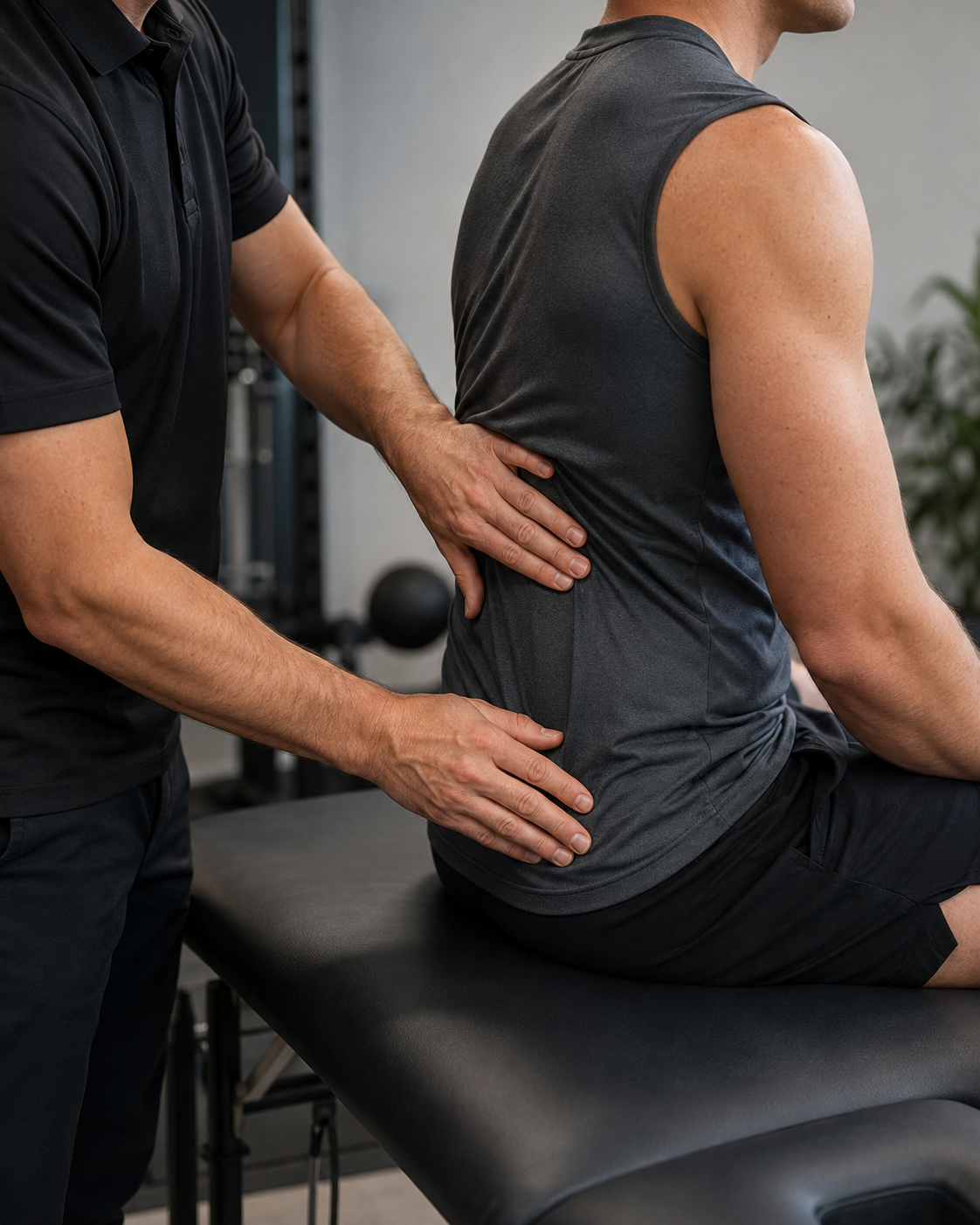
Few days ago, my regular HYROX Pro Division athlete came into K-Flow Therapy with repeated spasms around the right side of his rib cage and latissimus dorsi.
The timing of the competition and a few identifying details have been adjusted to protect his privacy.
About a week before the appointment, he had competed in a high-intensity fitness event. The competition left him extremely fatigued, but he returned to recovery training the following day and continued training without taking a complete rest day.
A few days later, he began experiencing sudden episodes of pulling and tightening around the right side of his rib cage and lat.
The symptoms were most noticeable when he took a deep breath. Sitting and standing were relatively comfortable, but lying on his back, side or front was difficult. He also reported that ibuprofen reduced the symptoms.
At first glance, it sounded like a fairly straightforward muscle spasm.
But the presentation did not quite behave like one.
What I Found During the Assessment
There was considerable tension through the right serratus anterior, latissimus dorsi and lower trapezius.
However, when he felt one of the spasms and I palpated the area, I could not feel the clear contraction, twitching or vibration that would normally be expected with an involuntary muscle cramp.
That does not completely rule out a spasm.
Some of the deeper muscles between the ribs are difficult to assess by touch, particularly while the rib cage is moving with breathing. Still, there were enough details that made me question whether this was simply a fatigued muscle repeatedly cramping.
Exercise-associated muscle cramps tend to occur during exercise or shortly afterwards. In this case, the symptoms appeared several days after the competition and were more sensitive to deep breathing and lying down than to exercise itself.
That changed the question.
Rather than asking which muscle was cramping, I started asking whether he was actually experiencing repeated muscle contractions at all.
It was possible that pain around the rib cage, a sudden catching sensation or a brief protective tightening response was being experienced and described as a spasm.
The sensation was real.
But the mechanism behind it may have been different from the language used to describe it.
The Competition May Not Have Been the Whole Story
I could not say that the competition directly caused the problem.
What seemed more likely was that the competition created a high level of fatigue and some local tissue irritation, then the continued training did not give the area enough time to settle.
The serratus anterior and latissimus dorsi both attach around the rib cage. The intercostal muscles move repeatedly with every breath. The joints where the ribs meet the thoracic spine are also loaded during deep breathing, trunk rotation and upper-body movement.
I could not confidently identify one structure as the source of the symptoms.
And I did not think attaching a specific label would improve the treatment decision at that point.
My working hypothesis was that the athlete’s capacity to tolerate load around the right side of the rib cage had temporarily dropped. Deep breathing and lying down then irritated the area, and the surrounding muscles increased their tension to protect it.
He may have been experiencing that protective response as repeated spasms.
Fatigue was likely part of the background, but I did not think there was enough information to describe this as central nervous system dysfunction. A more reasonable explanation was that local tissues had become highly irritable after a demanding competition followed by continued training and incomplete recovery.
A Necessary Note About Rib-Cage Symptoms
Symptoms linked with breathing should not automatically be treated as muscular.
Shortness of breath, worsening chest pain, coughing, fever, coughing up blood, unusual resting tachycardia or feeling systemically unwell would change the situation and require medical assessment.
Likewise, very localised tenderness over one rib or symptoms that repeatedly return with impact and loading may raise the possibility of a rib stress injury.
A plausible muscular explanation should never replace appropriate screening.
Why I Used Stronger Treatment This Time
At the appointment, his symptoms were severe enough that lying down was difficult.
Treatment included Dry Needling, targeted hands-on therapy, cupping and IASTM. The overall intensity was stronger than I would use in many sessions, but this was not an attempt to forcibly lengthen a shortened muscle or break down hardened tissue.
The intention was different.
I wanted to provide enough controlled sensory input to see whether the pain response and protective tension could be modulated in the short term.
Pressure, touch and needle stimulation provide the nervous system with new sensory information. This input may alter how pain is processed, while a stronger but controlled stimulus may also engage the body’s own pain-inhibiting systems.
That does not mean the nervous system has been reset.
It does not prove that a specific muscle has been released.
It simply creates an opportunity to see whether pain, breathing and movement can change.
My reasoning was that if the pain response settled, the body might no longer feel the same need to protect the area so aggressively. Breathing could become easier, movement could return, and the surrounding muscle tension might reduce as a consequence.
The treatment was strong because of how irritable the presentation was and because the athlete remained able to tolerate the input without becoming increasingly guarded.
Strong treatment is not automatically better treatment.
In this case, it was a deliberate choice based on the presentation in front of me.
What Changed After Treatment
By the end of the session, he was moving much more comfortably.
The spasm-like sensation that had appeared with deep breathing was no longer present.
The following morning, he sent me an update. The spasms had remained settled and his movement was returning. Before treatment, pain and repeated tightening had made it difficult to sleep. After the session, he went home, had a nap and then slept through the night.
That was a positive response.
It also supported the working hypothesis that local irritation and protective tension were contributing to the presentation.
But response to treatment is not the same as proof.
Several techniques were used during the session. Rest, sleep and natural recovery also occurred afterwards. It is not possible to isolate one technique and say that it corrected one specific structure.
Immediate improvement tells us that the symptoms were modifiable.
It does not tell us that the underlying problem has been permanently fixed.
Returning to Training Without Starting the Same Cycle Again
The next step was not complete rest.
It was also not an immediate return to full HYROX training simply because the spasms had stopped.
For the first day or two, the focus was comfortable walking or easy cycling, relaxed deep breathing and gentle thoracic rotation. High-intensity running, SkiErg, rowing, heavy sled work, burpees and loaded carries were temporarily reduced.
Aggressive stretching and self-release around the sore area were also discouraged. The area had already received a substantial amount of treatment input. Adding more pressure was unlikely to improve the response.
For the remainder of the first week, I recommended keeping his total training volume at approximately 60 per cent of normal.
He is an experienced athlete and capable of selecting his own sessions, but the overall load still needed a clear limit. Volume and intensity were not to be increased at the same time.
The most important measure was not simply how he felt during training.
It was how the rib cage responded later that day and the following morning.
If the spasms, catching with deep breathing or difficulty lying down returned, the load would need to come back down.
If the symptoms remained settled, the plan was to increase to approximately 80 per cent of his usual training volume the following week. Maximal sled work, high-intensity intervals and a full HYROX simulation would still be left out initially.
The aim was to gradually show that the area could tolerate breathing, movement and training load again without recreating the same protective response.
What This Case Was Really About
The words clients use matter.
But they do not always describe exactly what the tissues are doing.
Someone describing a spasm does not necessarily mean a muscle is visibly or continuously cramping. A muscle feeling tight does not automatically make that muscle the cause of the problem.
In this case, the important part was not finding the tightest muscle.
It was understanding why the symptoms appeared with deep breathing and lying down, whether an actual contraction could be detected, and what had happened with training load after the competition.
Treatment should not end when the symptoms temporarily disappear.
If hands-on treatment reduces a protective response, the next step is to use movement and gradually restored training load to help the area tolerate work again.
That is the part that matters most.
The goal was not to win the treatment session.
It was to help the athlete return to training without recreating the same problem a few days later.
That is how I approach sports and remedial therapy at K-Flow Therapy: assessment first, treatment based on what is in front of me, and a return-to-training plan that continues after the athlete leaves the room.
