
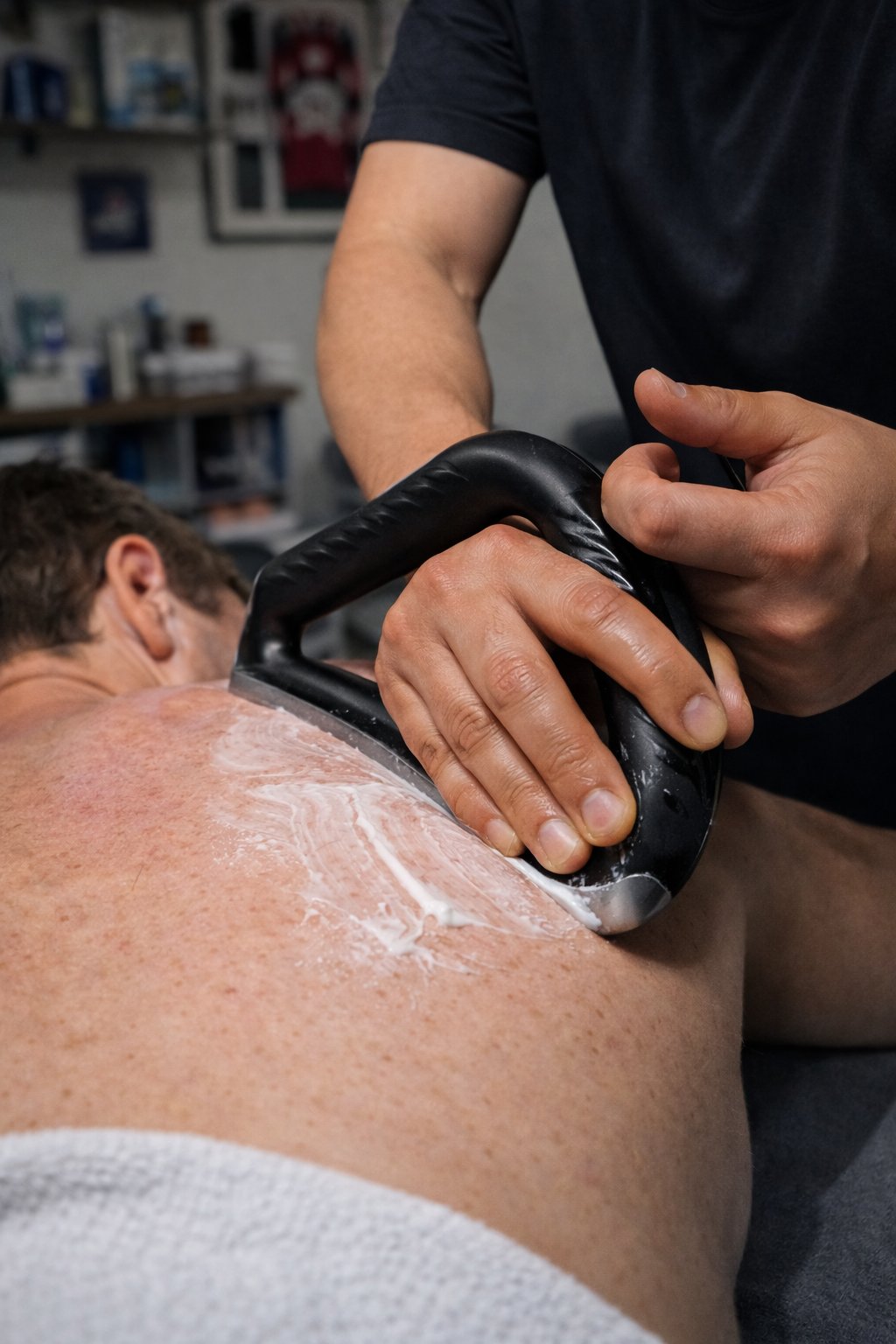
IASTM at K-Flow Therapy
Instrument Assisted Soft Tissue Mobilisation
Controlled tool-assisted treatment used selectively to reduce sensitivity, improve short-term movement tolerance, and prepare an area for exercise or loading.
What IASTM Is
IASTM stands for Instrument Assisted Soft Tissue Mobilisation.
It is a manual therapy approach that uses specialised tools to apply controlled pressure and movement over the skin and underlying soft tissue.
At K-Flow Therapy, IASTM is not used to aggressively scrape tissue or force an area to change. It is used as a measured form of mechanical and sensory input when it suits the client, the area being treated, and the overall treatment plan.
The pressure, speed, direction, and type of tool are adjusted based on how the area responds.
IASTM is not used routinely in every session. It is selected after assessment and only when there is a clear reason to use it.
Why My Explanation of IASTM Has Changed
An earlier version of this page described IASTM as a way of reducing the viscosity of hyaluronic acid within the fascial layers and improving fascial glide.
At the time, I thought this was a reasonable explanation for some of the changes I was seeing in the clinic.
Hyaluronic acid does play a role in tissue hydration and movement between connective tissue layers. Its physical behaviour can also change under different conditions.
However, that does not necessarily mean a therapist can physically liquefy hyaluronic acid, release an adhesion, or permanently change fascia by moving a tool over the skin.
The theory may be biologically plausible, but there is not enough clinical evidence to present it as an established explanation for what happens during IASTM treatment.
As I have continued studying the evidence, my view has become more cautious.
I now see IASTM primarily as a way of providing controlled mechanical and sensory input. This input may temporarily change how sensitive, guarded, or comfortable an area feels and may allow someone to move through a greater range with less hesitation.
That change can be useful.
But an immediate change in pain, stiffness, or movement does not prove that tissue has been broken down, an adhesion has been removed, or the underlying problem has been permanently fixed.
I would rather update the explanation than continue repeating something simply because it sounds scientific or convincing.
My Clinical View on IASTM
I view IASTM as a supporting technique, not a standalone treatment and not a method of physically correcting damaged tissue.
Its main value is creating a short-term opportunity for better movement.
For example, an area may feel less sensitive after treatment, a previously uncomfortable movement may become easier, or a client may feel more confident loading the area.
The purpose is then to use that opportunity.
When possible, the short-term response is followed by movement, exercise, or a gradual return to load. This helps determine whether the change is meaningful and whether it can carry into training, work, or daily activity.
IASTM may help create the window, but it is what happens afterwards that is more likely to influence long-term progress.
How I Use IASTM
IASTM may be used to:
reduce sensitivity in an irritable or guarded area
improve short-term tolerance to movement
provide a different form of sensory feedback
prepare an area for exercise or progressive loading
make hands-on treatment more tolerable when deep pressure is not appropriate
assess whether a change in symptoms improves function
The area is reassessed after treatment.
If movement becomes easier, the next step may involve an exercise, a functional movement, or a gradual exposure to the activity that has been causing difficulty.
If there is no useful change, I do not continue using the technique simply because it is available.
Tools Used at K-Flow Therapy
The tool is selected based on the area being treated, the client’s sensitivity, and the goal of the session.
Heated and Vibrated IASTM Tools
I use heated and vibrated IASTM tools from Achedaway.
Heat and vibration provide a different type of sensory input and can make treatment more comfortable without relying on heavy pressure.
This option may be useful for larger areas or when the client is sensitive to more direct or focal treatment.
The temperature, vibration level, and pressure are adjusted throughout the treatment based on the client’s response.
Stainless Steel IASTM Tools
Traditional stainless steel tools may be used when more precise contact is required.
They allow closer control over:
the size of the treatment area
the amount of pressure applied
the direction and speed of the movement
how focal or broad the input feels
The sensation felt through the tool does not automatically confirm the presence of scar tissue, an adhesion, or structural damage.
The tool provides feedback, but that feedback must still be interpreted alongside the client’s symptoms, movement, history, and response to treatment.
When IASTM May Be Considered
IASTM may be considered when someone presents with:
an area that feels persistently stiff or guarded
discomfort that limits movement or exercise
short-term loss of movement after training or repetitive activity
sensitivity that makes deeper hands-on treatment difficult
movement hesitation following pain or injury
symptoms that may benefit from a different form of sensory input
It may be used with athletes, runners, cyclists, gym-goers, active workers, and clients managing discomfort related to repetitive or sustained physical load.
The presence of tightness alone is not enough reason to use it.
The decision is based on whether the technique is likely to help the client move, load, or function more comfortably.
What IASTM Does Not Mean
IASTM does not need to be painful to be effective.
More pressure does not automatically produce a better result.
Bruising is not evidence that scar tissue has been broken down, and visible marks are not used as a measure of treatment quality.
I do not use IASTM on the assumption that the tool is:
breaking down adhesions
scraping away scar tissue
realigning collagen fibres
permanently lengthening fascia
releasing toxins
correcting a problem without movement or loading
Some clients experience an immediate improvement after treatment. Others notice little change.
Both responses provide useful information and help guide what happens next.
How IASTM Fits Into Treatment
IASTM is not treated as a complete treatment plan.
When appropriate, it may be combined with:
remedial or sports massage
myofascial techniques
dry needling
cupping
movement assessment
simple mobility or activation exercises
load and recovery guidance
The combination depends on the client’s presentation. Techniques are not added simply to make the session feel more comprehensive.
The focus remains on understanding what is limiting movement or function and selecting the smallest useful combination of treatment and exercise.
What Treatment Feels Like
IASTM usually feels like firm, controlled gliding over the skin.
Depending on the tool and treatment area, it may feel smooth, warm, vibrated, or slightly scraping.
Pressure is adjusted throughout the session. Mild discomfort can occur, but intense pain is not required and is not the goal.
Temporary redness or warmth may appear in the treated area due to local skin and circulatory responses.
Excessive redness, skin irritation, and bruising are intentionally avoided.
Safety and Suitability
IASTM is not suitable for every person or every area.
Before treatment, I consider the client’s medical history, medications, skin condition, recent injuries, and sensitivity to pressure.
Treatment may need to be modified or avoided around:
broken or irritated skin
active skin infections
significant bruising or swelling
recent surgery
suspected fractures or acute trauma
areas with altered sensation
vascular or bleeding concerns
Clients should mention blood-thinning medication, bleeding disorders, recent procedures, or any condition that may affect skin or tissue tolerance.
When IASTM is not appropriate, another treatment approach will be used.
Performed by a Certified Practitioner
All IASTM treatments at K-Flow Therapy are performed by Sam, a qualified remedial massage therapist with formal training in instrument-assisted techniques.
Sam holds a RockBlade® IASTM Certification through RockTape.
This training covered safe tool handling, pressure selection, treatment planning, and the integration of IASTM with movement-based care.
Certification provides technical training, but it does not replace assessment or clinical reasoning.
The technique is still adjusted to the individual rather than applied through a fixed protocol.
Is IASTM Right for You?
IASTM may be useful when pain, sensitivity, or stiffness is making movement or exercise difficult and a controlled form of tool-assisted treatment is appropriate.
It may also be useful when standard massage is uncomfortable or has not provided a meaningful change.
It is unlikely to be the complete answer on its own.
During your session, I will assess your symptoms, movement, and physical demands before deciding whether IASTM is appropriate. I will also explain what I am using it for and reassess whether it has produced a useful response.
The goal is not to use as many techniques as possible.
The goal is to help you move more comfortably and build a realistic path back towards training, work, or daily activity.