
Why Footwear Can Contribute to Foot and Lower-Leg Pain
Working with athletes and everyday clients over time, certain patterns start to appear, not occasionally, but consistently.
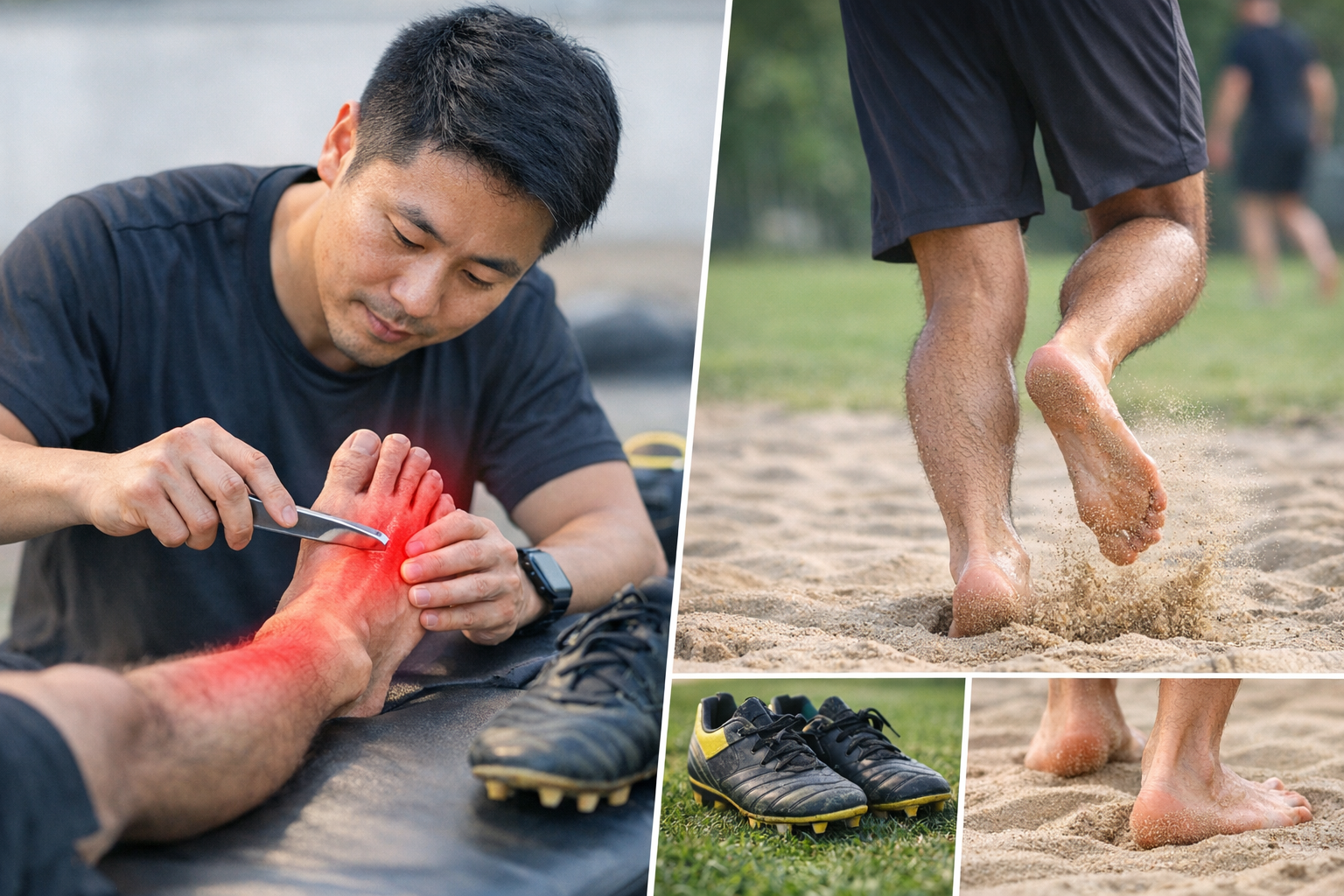
One recurring pattern involves pain around the big toe, a dull ache over the top of the foot, and shin discomfort often described as “shin splints.” This shows up frequently in footy players, particularly those wearing football boots with a stiff outsole, a curved sole profile, and a narrow toe box.
Footwear with these characteristics can restrict natural toe movement. During the toe-off phase, this restriction appears to place extra load through the big toe and the extensor tendons across the top of the foot. Over time, that stress doesn’t stay local. Repetitive tension often develops through the soleus and tibialis anterior/posterior, areas commonly linked to lower-leg pain.
A consistent clinical observation has been that soft tissue work to the top of the foot, particularly using IASTM, often produces immediate relief. When symptoms change that quickly, it suggests the issue may not be purely strength-related, but linked to restricted tissue glide and reduced sliding between structures.
Not Just an Athlete Issue
This pattern isn’t limited to sport.
Similar symptoms are often seen in clients who spend long hours wearing heavy, rigid work boots. Steel caps, stiff soles, and limited forefoot flexion can compress the toes and restrict foot motion in much the same way. The result is unnecessary tension through the top of the foot and into the lower leg, a pattern that mirrors what’s seen in athletes, just under different loads.
Different environments, different demands, but a surprisingly similar outcome.
What Changes When the Foot Is Allowed to Move
An interesting shift occurs when rigid footwear is temporarily taken out of the equation.
When barefoot walking or running is introduced on grass or sand, many clients report a noticeable reduction in toe and lower-leg discomfort. On sand, the foot naturally adapts. Intrinsic foot muscles become more active, toes spread more freely, and movement at the MTP joints improves.
In practical terms, this kind of surface encourages the foot to work as a dynamic structure again, rather than a rigid lever. Over time, this appears to reduce unnecessary load through the extrinsic muscles of the lower leg.
From Observation to Practical Strategy
This isn’t about lab data or controlled trials, it’s about consistent patterns seen in real people.
Footwear with stiff soles, curved profiles, and narrow toe boxes, whether in sport or at work, appears to limit natural foot mechanics and shift load elsewhere. Addressing this solely by treating the painful area often misses the bigger picture.
Soft tissue mobilisation can help reduce overload and restore tissue tolerance. Barefoot movement, when introduced appropriately, can help re-introduce natural motion and improve how the foot absorbs load.
Rather than forcing change, the goal is to remove unnecessary restriction and allow the body to do what it’s designed to do.
Sometimes recovery doesn’t start with doing more, it starts with giving the foot room to move.
