
Shoulder Pain, Back Pain, and the Problem with “Patterns”
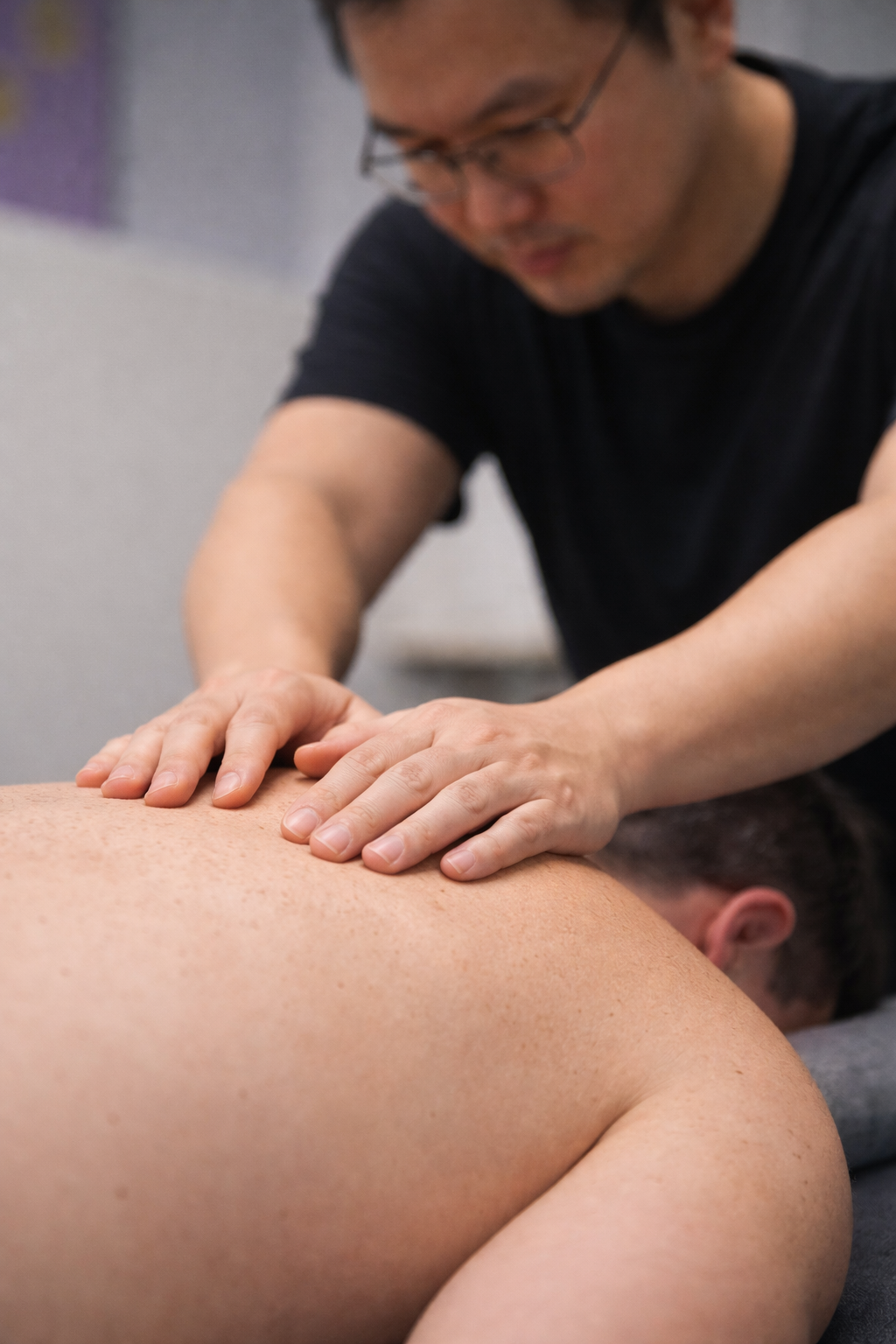
Lately, I’ve noticed that the people who come to see me for shoulder pain or lower back pain are starting to sound very similar.
The pain shows up in different places, but once we talk for a few minutes, common themes appear. In many cases, the discomfort began with postural strain or repetitive movements. Almost everyone has already tried to understand their symptoms through YouTube or AI before booking an appointment.
Online, the most common explanations people encounter are based on patterns.
A certain posture, a specific pelvic position, or a particular body type is often presented as the main cause of pain. These explanations are short, clear, and easy to follow. From a viewer’s perspective, they’re appealing. They create that quick moment of recognition “That must be me.”
Breaking the body into a small number of categories fits neatly with how modern health content is consumed.
But when you work hands-on with people dealing with chronic pain, sports injuries, or movement-related discomfort, a different question keeps coming up.
"Can human pain and movement really be reduced to a few simple patterns?”
What I’m sharing here isn’t a final answer. It’s closer to an ongoing observation from the treatment room, shaped by clinical experience and the questions that keep resurfacing.
Pain Is Rarely Local
When someone presents with right shoulder pain, it’s common to find tightness through the left hip and glute. Quite often, there’s also increased tone through the hip flexors. In many cases, this can be explored without attaching a specific label or diagnosis pattern.
The body doesn’t work in isolated parts.
Force travels from the ground, through the pelvis and trunk, into the shoulder and arm. This transfer is rarely straight-line. It’s rotational and diagonal, what we often describe in remedial massage and sports therapy as a kinetic chain that crosses the body.
When a shoulder becomes painful, people naturally stop using it the same way. Load shifts elsewhere. Rotation reduces. The opposite side of the pelvis often takes on more work. The glutes may start handling both stability and propulsion, while deeper muscles like the psoas begin functioning more as a brake than a mover.
In many of the cases I see clinically, this looks less like a “faulty pattern” and more like a protective strategy the body has adopted to avoid pain.
Why Pattern-Based Explanations Can Be Limiting
This is where pattern-based explanations need to be handled carefully.
Saying something like “I’m Left AIC” can be a quick way to organise a complex situation, and it’s easy to see why that language is appealing. However, it also tends to compress multiple contributing factors into a single framework.
Once that happens, treatment can drift toward a one-size-fits-all approach, the same corrective exercises, the same cues, the same assumptions, regardless of the individual sitting in front of you.
In practice, I’ve also noticed that many of the people most actively promoting these pattern-based ideas online are not clinicians. In many cases, they haven’t completed formal PRI training either. More commonly, fragments of theory are borrowed without the clinical depth, constraints, or context that the original framework requires. When that happens, nuance disappears and only simplified conclusions remain.
A Different Question in the Treatment Room
Because of this, the question I ask most often in practice isn’t “What pattern is this person?”
It’s “What choice is this body making right now?”
Repetitive work, one-sided loading, pain avoidance, fatigue, stress, and training load all stack together. In that moment, the body tends to choose whatever feels safest. That choice isn’t fixed. As symptoms change, the body’s strategy can change too.
This perspective matters when working with ongoing shoulder pain, lower back pain, sports injuries, or persistent muscular tightness. Treating the body as adaptable, rather than defective, changes how recovery is approached.
Fixing Pain vs Supporting Recovery
Online, it’s common to hear that if a problem is simplified enough, it can be fixed.
I struggle with that idea.
When therapists believe they can fix pain, it often reflects an underestimation of how complex and unpredictable the human body really is. Regardless of discipline, I don’t believe a therapist should assume they can fix someone’s body.
Understanding pain doesn’t grant ownership over recovery. The moment a therapist believes they can fix a person, their role becomes inflated. That isn’t confidence, it’s closer to arrogance.
Therapists don’t fix people.
From my perspective, our role is to support the conditions that allow recovery to happen. Treatment is less about correction and more about accompaniment. My job isn’t to “fix” muscles, but to help create an environment where the body has more options again. When we promise more than that, treatment risks becoming illusion rather than help.
How We Support Recovery at K-Flow Therapy
This is also how I approach my work at K-Flow Therapy.
Rather than fitting people into predefined patterns, I focus on understanding the context in which pain developed. That includes posture, training load, work demands, movement habits, and how the body has adapted over time. Hands-on therapy is only one part of the process. Breathing, movement re-education, and everyday habits all matter, because they influence how the body self-regulates outside the treatment room.
The goal isn’t to correct a pattern.
It’s to reduce unnecessary load, restore movement options, and support the body’s ability to adapt again.
Patterns can be useful maps, but they are not the terrain. A map can guide direction, but the person standing on it changes day to day. What matters most to me isn’t attaching labels, but helping people regain choices in how they move.
At K-Flow Therapy, support means standing alongside that process, not trying to control it.
