
A Fast Bowler’s Knee: When the Problem Isn’t Injury, But Load Management
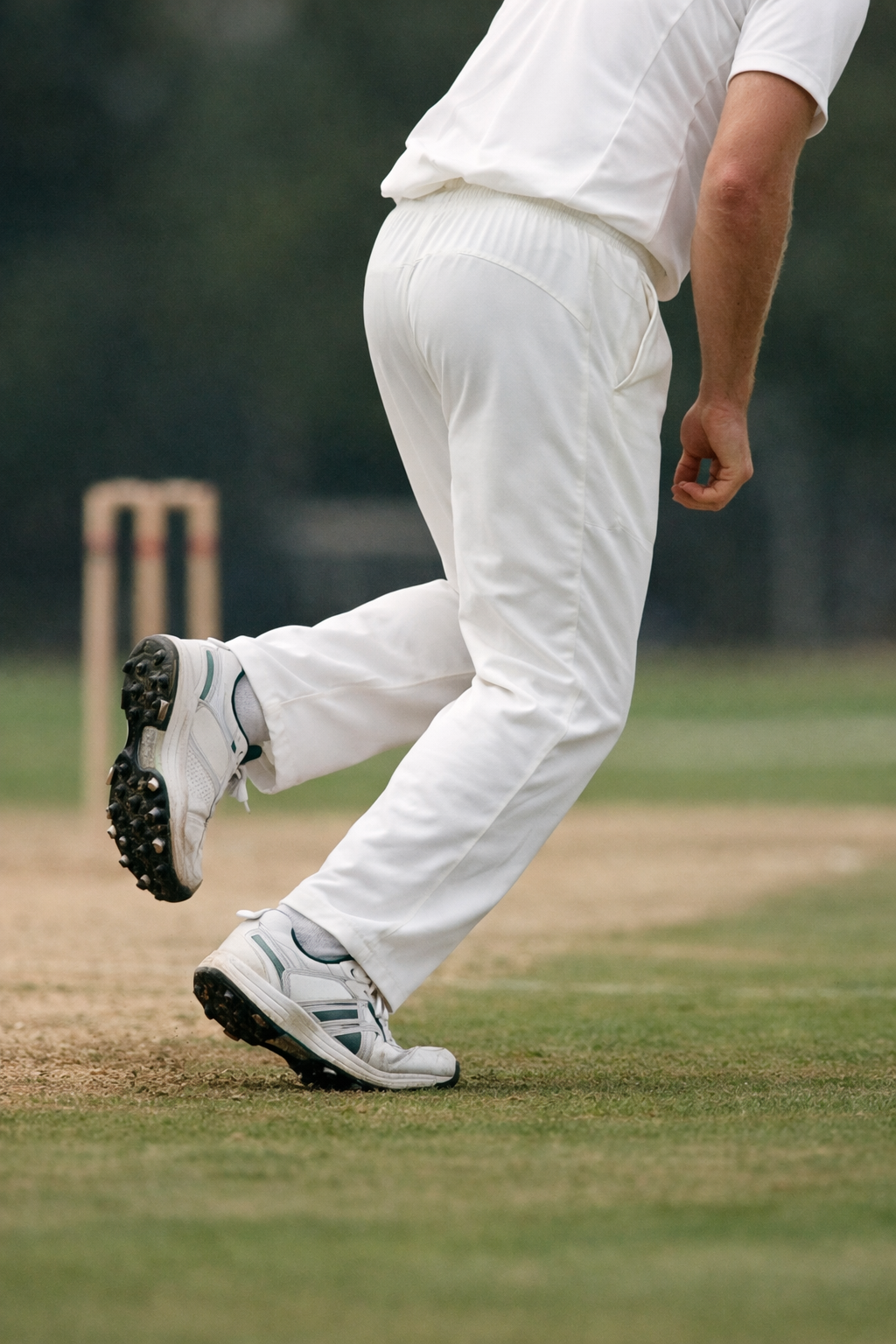
Yesterday afternoon, a cricketer with previous professional experience in India came into the clinic.
He’s now playing local cricket as a fast bowler, working under a contract-based setup. If he doesn’t play, income drops straight away. That reality shapes how he trains and how he thinks about his body.
A few months ago, he twisted his knee while batting and was ruled out. Since then, something hasn’t quite settled.
Not so much in the knee itself, but in his trust in it.
He’s a big athlete, around 6’8”, heavily built, and currently weighing more than 100kg. He mentioned that during his time playing professionally overseas, he was more than 10 kg lighter. Naturally, he’d started linking the weight change directly to his knee problem.
But from my point of view, that wasn’t the full picture.
If his knee allows it, that size and mass can actually be an advantage for a fast bowler. The issue isn’t bodyweight itself, it’s how the body is receiving and distributing the force that comes with it.
Assessment: not damaged, but holding load
On assessment, there were no signs of structural damage.
No ligament instability. No acute injury. His imaging was clean.
What I did see was strong tension through the entire right lower limb, along with clear protective movement patterns. There was some swelling around the medial side of the knee, but very little pain.
This didn’t look like a knee that had been re-injured.
It looked more like a knee that had been accumulating load without clearing it properly.
Treatment: looking beyond the knee
Treatment wasn’t focused on the knee alone.
We worked through the entire lower-limb chain, including the glutes, using dry needling and myofascial release to settle things down. To help reduce the load sitting around the medial knee, lymphatic-style work was added.
By the end of the session, he said his leg felt lighter.
More accurately, movement felt smoother.
What stayed with him wasn’t the pain
He mentioned that after his last injury, he was left out of the squad for a period.
It felt like the memory of that time sat deeper than the pain itself.
I explained that structurally his knee is in good shape, and that with proper rehab and load management, returning to his previous level is a realistic goal.
Training direction: slowing down, not pushing harder
When I explained the training approach, I avoided vague language and used simple examples.
The first focus was deceleration.
Not sprinting or stopping hard, but learning to slow down quietly on one leg and absorb force without letting it pile into the knee.
In his case, the issue wasn’t running.
It was how force was being stored at the knee during the stopping phase.
We added very light weight ball throws, around 100-150 g. Not to build power, but to feel timing. I told him not to throw hard, but to wait and let the movement happen.
For a fast bowler, what matters most isn’t one explosive effort, but a rhythm that can be repeated over and over.
Step-downs, not bracing
Step-down movements were included as well.
Not jumping from height, but stepping down from low levels and moving straight into the next action.
The aim wasn’t to stop and brace, but to receive force and let it flow through the body again. Throughout this, we will keep checking that the hips and trunk were sharing the work, instead of leaving the knee to handle everything alone.
A simple way to explain it
To tie everything together, I shared a line from a Japanese trainer that I often come back to the words what Osamu Yada said,
“Using 600 muscles at 10 % is often stronger than relying on a few at 80–90 %.”
This knee wasn’t struggling because it was weak.
It was struggling because it had been doing too much on its own.
What this case is really about
He’s 28. With a bit of luck, there’s still a pathway back to higher-level cricket. More realistically, securing consistent contracts matters more right now than long-term plans.
For him, this isn’t about a story or an outcome.
It’s about keeping his knee from quietly accumulating load, and making sure his body can handle regular training and match schedules.
If he can move through his weeks without unnecessary setbacks, stiffness, or swelling, then the purpose of this work has been met.
